
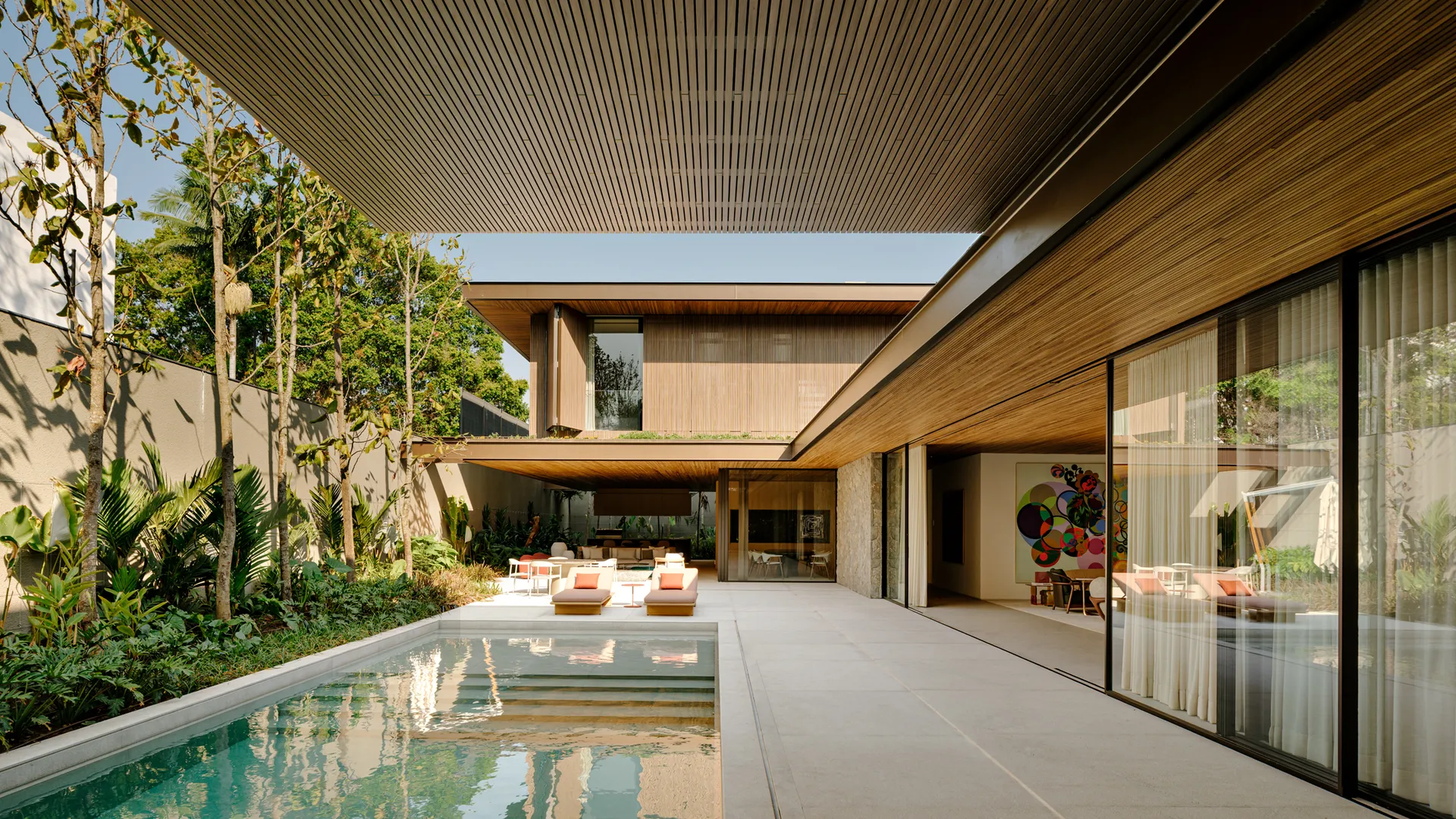
From the inside, you’d never know this home was located in one of São Paulo’s most densely populated areas. Its airy design was born of a challenge: a family who wanted to live in the city centre, but without giving up the feeling of being surrounded by greenery, light and silence. Local firm Fernanda Marques Arquitetura developed the project intuitively. “What guided me was the owners’ wish for a home that could accommodate different rhythms simultaneously, so spaces allow social interaction, but also quiet, and moments for work,” says Marques. “There was a clear intention to create an environment where the boundaries between indoors and outdoors would dissolve.”
Gradually, as Marques experimented with her design for this São Paulo home, a coherent concept emerged: a dialogue between solids and voids, which interlock in a way that defines shadows against light, sheltered spaces against wide-open vistas. The architect was reminded of something from her past. “I realised that the house was naturally organising itself into distinct blocks – some elevated, others cantilevered, and creating a dynamic balance. It immediately reminded me of the Lego structures we built as children, stacking pieces and discovering equilibrium.”

The finished São Paulo home is charmingly named Casa Lego. It unfolds across three floors and houses four self-contained bedroom suites, each with its own bathroom and dressing room. There are also two pools – one indoors, one outdoors, the latter visible throughout most of the house – and a garden planted with tropical species. “The brief was to create a home that could close itself from the city noise, but remain in communication with light and nature,” Marques explains. “The landscaping was designed to feel immersive, reinforcing the idea that the house is surrounded by greenery. The intention was not to create a formal garden, but rather a living, evolving landscape that interacts with the architecture. On the roof, planting contributes to thermal comfort while further blurring the distinction between built form and nature.”
.jpg)

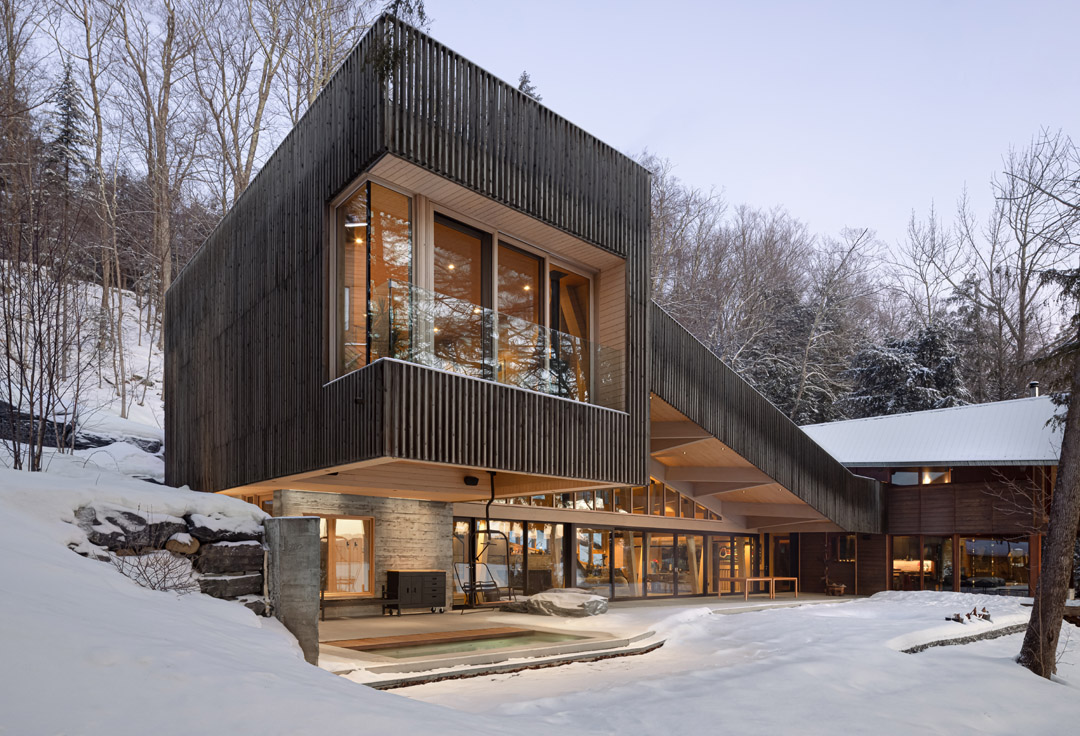
The building’s streamlined design meant that materiality was key. Much of the façade is clad in slatted laminated timber, which also appears on ceilings, and on brise-soleils on the upper storey. “The brise-soleils contribute to passive environmental control, enhancing ventilation and reducing solar gain,” says Marques. “Sustainability here is not treated as an add-on, but as a natural outcome of design decisions. We used travertine extensively, both indoors and in the pool, for a sense of permanence and calm. Textured moledo stone introduces a tactile, almost primitive quality, grounding the architecture and connecting it to the landscape.” Aside from these, refined touches create a feeling of quiet luxury: the underground entrance to the house is defined by a Mondrian-esque grid of doors in Corten steel and textured glass, which “serve not only as a functional threshold, but as a graphic, almost artistic intervention”.


To make the interiors feel warm and liveable, Marques focused on earthy textures and neutral colours, designing a lighting system concealed within wooden panelling that illuminates surfaces and focal points. “Light is as essential a material as steel or wood. It shapes space, reveals textures and brings architecture to life,” she reflects. “I introduced colour in a very controlled way, through specific furniture and artworks, so that it appears almost as punctuation within the space rather than a constant presence.”


The furniture is a mix of Brazilian and Italian design, by names such as Gustavo Neves and Antonio Citterio. “Most of the furnishings follow a restrained vocabulary, with clean lines and sculptural presence, but a few elements introduce subtle moments of contrast,” says Marques. Among these are a graphite-painted metal staircase whose spiral form is a counterpoint to the linear architecture; and islands and display niches in opulent black Kilimanjaro granite. “On the terrace, Paola Lenti’s furniture introduces colour as a connecting element, including a handcrafted tile coffee table that brings a sense of uniqueness.”


Artworks, both newly acquired and from the family’s existing collection, lend emotional weight. Their favourite artist is the Brazilian Beatriz Milhazes, whose colourful oversized canvas creates a moment of intensity in the main living space. Two works by Japanese-Brazilian painter Takashi Fukushima add further depth to the narrative: one beside the otherwise unadorned spiral staircase, and another propped on an easel in the living room. “This was thoughtfully conceived as a way to bring the work into focus,” explains the architect. “This is a project where architecture is about perception — how spaces are revealed, how light moves, how materials age. There is always a dialogue between precision and softness, between what is built and how it changes.”


Source: admiddleeast.com

Copyright © 2026. Azayzeh. All rights reserved.